Most business processes that people want to hand to "an AI agent" do not need an agent. They need a workflow with one or two AI steps inside it. The difference decides what the project costs, how predictable it is, and how much testing it takes before you can trust it.
Short answer: if you can write the steps down in advance, build a workflow. If the steps change with every case and you cannot list them ahead of time, consider an agent, and keep a person in the loop for anything that is hard to undo.
What is the difference between an AI agent and an AI workflow?
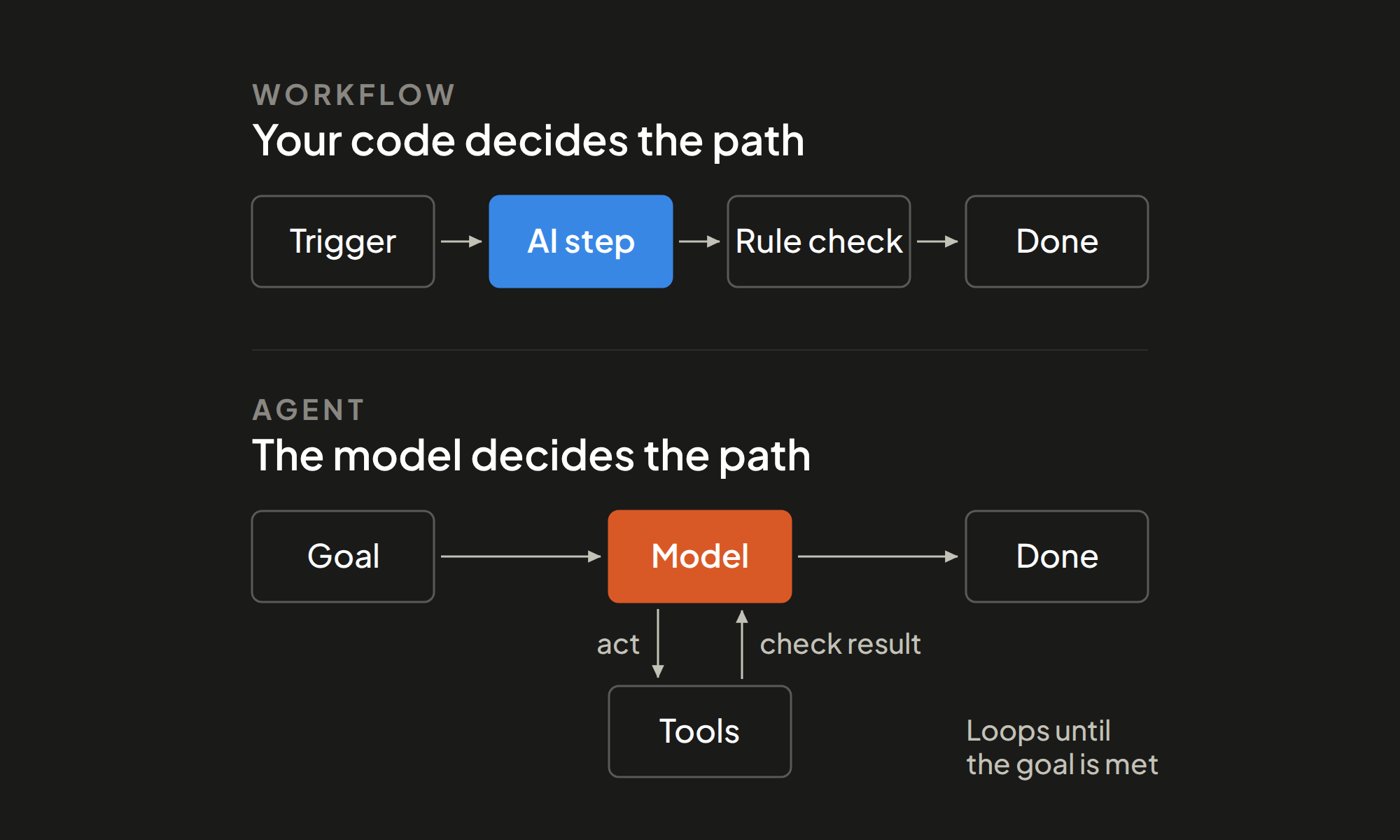
The clearest definitions come from Anthropic's engineering guide, Building Effective AI Agents. It describes workflows as "systems where LLMs and tools are orchestrated through predefined code paths." Agents are "systems where LLMs dynamically direct their own processes and tool usage."
In plain terms: in a workflow, your code decides what happens next. In an agent, the model decides what happens next. Both can use the same AI models. Both can read documents, draft emails, and update a CRM. The difference is who holds the map.
What each one looks like in practice
Take invoice intake. An email arrives with a PDF. The system extracts the vendor, amount, and due date, checks the total against a purchase order, and either posts it to accounting or sends it to a person. The steps are the same every time. Only the reading of the PDF needs AI. That is a workflow.
Now take researching an inbound lead. The useful facts might sit on the company's website, in a news article, in your CRM history, or nowhere at all. What to look up next depends on what the last lookup found. Nobody can write that path down in advance. That is closer to agent territory.
AI workflow vs AI agent at a glance
| AI workflow | AI agent | |
|---|---|---|
| Who picks the next step | Your code, on a path set in advance | The model, based on what it has seen so far |
| Predictability | High. The same input takes the same route. | Lower. Two runs can take different routes. |
| Cost and speed per task | Lower and easier to forecast | Higher. An agent makes more model calls per task. |
| Testing | Test each step and each branch | Test against many real cases and review the paths taken |
| Fits best | Repeatable processes with known steps | Open-ended tasks where the steps cannot be listed ahead of time |
| Main risk | Stalls when a case falls outside the path | Errors that compound from one step to the next |
Start with the simplest thing that works
Anthropic's advice is blunt: "we recommend finding the simplest solution possible, and only increasing complexity when needed." The same guide notes that agentic systems "often trade latency and cost for better task performance," so the real question is whether that trade is worth it for the task in front of you.
Workflows are not the weak option. The guide describes five workflow patterns that handle many common business automations:
- Prompt chaining. One step feeds the next, such as draft, then check, then translate.
- Routing. Classify the input, then send it down the right path, such as sorting support email by type.
- Parallelization. Run several checks at once and combine the results.
- Orchestrator-workers. One model splits a job into parts and hands them to others.
- Evaluator-optimizer. One model drafts, a second reviews, and the loop repeats until the draft passes.
Three signs a process may need an agent
OpenAI's A Practical Guide to Building Agents gives three criteria for when an agent is worth building:
- Complex decision-making. The work involves judgment calls, exceptions, or decisions that depend on context.
- Rules that are hard to maintain. The rulebook has grown so large that every change is costly and error-prone.
- Heavy reliance on unstructured data. The work means reading documents, interpreting natural language, or holding a conversation.
If a process does not clearly meet these criteria, the guide reaches its own conclusion: "Otherwise, a deterministic solution may suffice."
Why caution pays
In June 2025, Gartner predicted that over 40% of agentic AI projects will be canceled by the end of 2027, "due to escalating costs, unclear business value or inadequate risk controls." That is a forecast, not a measurement, but the three reasons it names are the ones a simpler design helps you avoid.
Gartner also warned about "agent washing," where vendors rebrand existing products such as AI assistants and chatbots as agents. It estimated that only about 130 of the thousands of agentic AI vendors are real. If a vendor calls a fixed sequence of steps an agent, you may be paying an agent price for a workflow.
If you do build an agent, build the guardrails first
Anthropic's guide is direct about the trade: "The autonomous nature of agents means higher costs, and the potential for compounding errors. We recommend extensive testing in sandboxed environments, along with the appropriate guardrails."
In practice that means four things:
- Narrow permissions. Connect the agent only to the systems it needs, with the least access that works.
- Human approval for high-stakes actions. OpenAI's guide says actions that are "sensitive, irreversible, or have high stakes" should trigger human oversight until confidence in the agent's reliability grows.
- A test set of real cases. Measure the agent against examples from your own business before it touches live data.
- Full logging. Record every step so a person can see what the agent did and why.
A five-question test for your own process
- Can you write down the steps in advance? If yes, start with a workflow.
- Do the inputs arrive in a consistent format? If yes, a workflow with one AI step to read them is usually enough.
- How often do exceptions come up? Rare exceptions can go to a person. Constant exceptions point toward an agent.
- What does a wrong action cost? The higher the cost, the stronger the case for fixed steps and human approval.
- Do you have real examples to test against? If not, collect them before building either one.
A mix is often the sensible result: a workflow for the predictable bulk of the work, and a narrowly scoped agent or a person for the cases that fall outside it.
How Lean Discovery Group approaches the choice
Lean Discovery Group is a software development firm that builds both. Our AI workflow automation work connects the tools a team already uses and adds AI only to the steps that need reading, sorting, or judgment. Our AI agent development work is for the jobs that cannot be reduced to fixed steps, and every agent ships with guardrails, human approval for high-stakes steps, and monitoring.
If you are not sure which one your process needs, that question is part of our AI automation services, and we will say so when the answer is the smaller project. Book a discovery call to talk it through.
Frequently asked questions
Is an AI agent better than an AI workflow?
Neither is better in general. A workflow is more predictable and cheaper to run when the steps are known. An agent handles open-ended tasks where the steps cannot be listed in advance. Anthropic recommends finding the simplest solution possible and adding complexity only when needed.
Can a workflow use AI without being an agent?
Yes. A workflow can include AI steps that classify an email, extract fields from a document, or draft a reply. It is still a workflow as long as your code, not the model, decides what happens next.
Are AI agents more expensive to run than workflows?
Usually, per task. An agent makes more model calls because it plans, acts, and checks its own results in a loop. Anthropic notes that agentic systems often trade latency and cost for better task performance.
Can you start with a workflow and move to an agent later?
Yes, and it is a sensible order. A working workflow gives you logged examples, a baseline, and a clear list of the cases it cannot handle. Those cases show whether an agent is worth building.
What is agent washing?
Gartner uses the term for vendors that rebrand existing products, such as AI assistants and chatbots, as AI agents without real agentic capability. In June 2025 it estimated that only about 130 of the thousands of agentic AI vendors are real.