Almost every statistic you have seen about lead response time traces back to two studies, one from 2007 and one from 2011. Both point the same way: the sooner you reply to a new inquiry, the more likely you are to reach and qualify that person. But the numbers are often quoted without their context, and some of what gets repeated is stronger than what the research shows.
Short answer: reply within minutes if you can, and within the hour at the latest. Then measure your own numbers, because the published multiples come from other companies in another decade.
The two studies behind most lead response statistics
Harvard Business Review, 2011
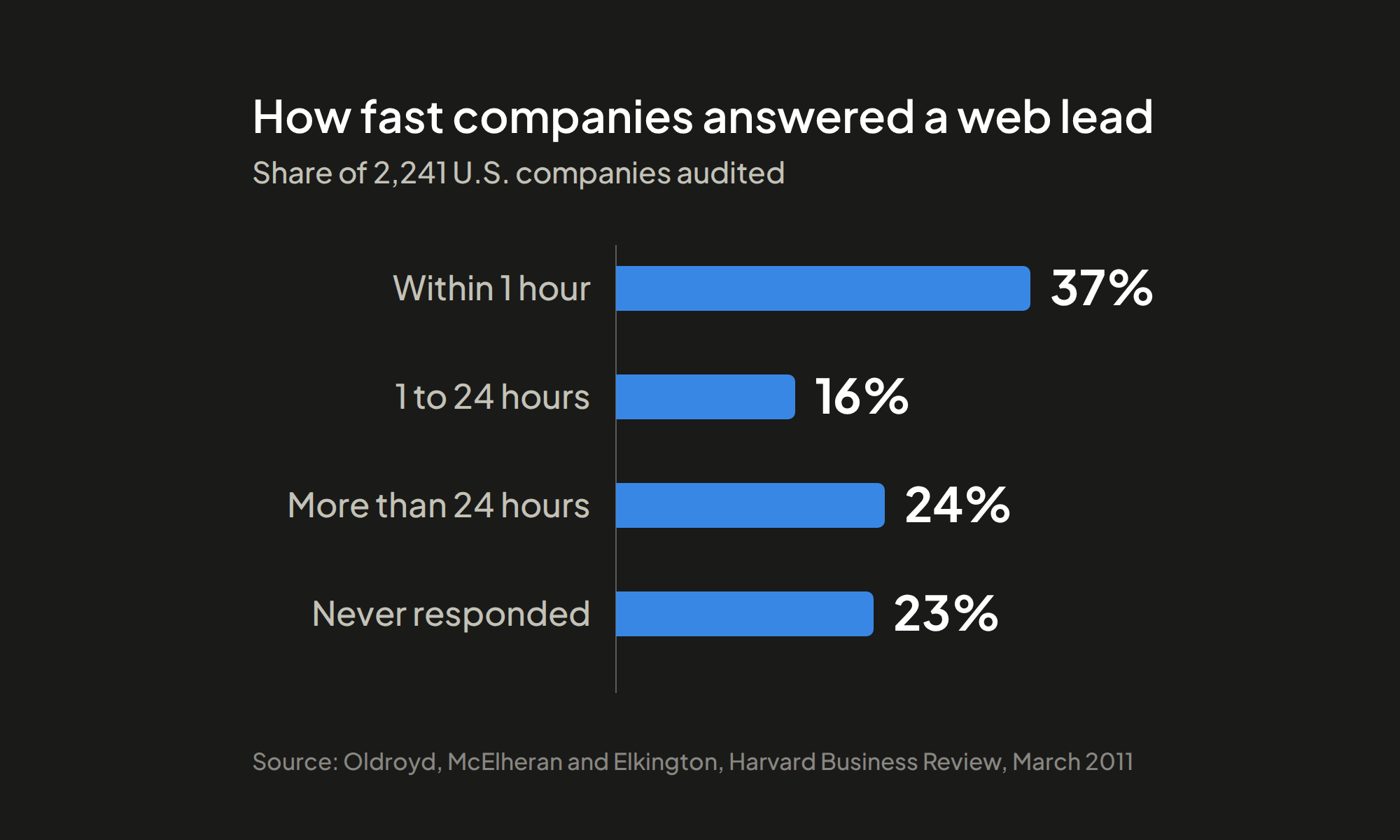
In The Short Life of Online Sales Leads, James Oldroyd, Kristina McElheran, and David Elkington audited how 2,241 U.S. companies handled a web-generated lead. The chart at the top of this article shows the result: 37% responded within an hour, 16% within one to 24 hours, 24% took more than 24 hours, and 23% never responded at all. Among the companies that responded within 30 days, the average response time was 42 hours.
The same article reports a separate study involving 1.25 million sales leads received by 29 B2C and 13 B2B companies in the U.S. Firms that tried to contact a lead within an hour were nearly seven times as likely to qualify it as firms that tried even an hour later, and more than 60 times as likely as firms that waited 24 hours or longer. The authors defined qualifying a lead as having a meaningful conversation with a key decision maker.
The Lead Response Management Study, 2007
The older study came from InsideSales.com, a sales software vendor, working with James Oldroyd, then a faculty fellow at MIT. It examined three years of data from six companies, covering more than 15,000 leads and more than 100,000 call attempts (archived copy). Its two best-known findings: the odds of contacting a lead dropped 100 times when the first call came at 30 minutes instead of 5 minutes, and the odds of qualifying a lead dropped 21 times over the same gap. This is where the "five-minute rule" comes from.
Lead response time statistics in one place
| Finding | Number | Source |
|---|---|---|
| Companies that replied to a web lead within one hour | 37% | HBR, 2011 |
| Companies that never replied | 23% | HBR, 2011 |
| Average response time among companies that replied within 30 days | 42 hours | HBR, 2011 |
| Odds of qualifying a lead: contact within one hour vs one hour later | Nearly 7 times higher | HBR, 2011 |
| Odds of qualifying a lead: contact within one hour vs 24 hours or more | More than 60 times higher | HBR, 2011 |
| Odds of contacting a lead: first call at 5 minutes vs 30 minutes | 100 times higher | Lead Response Management Study, 2007 |
| Odds of qualifying a lead: first call at 5 minutes vs 30 minutes | 21 times higher | Lead Response Management Study, 2007 |
What the research does not prove
- The data is old. Both studies are more than a decade old. Buyers now text, use chat, and expect instant replies in ways they did not then. The direction of the finding is unlikely to have reversed, but the exact multiples may not hold today.
- The 2007 study measured phone calls. It says nothing direct about email, text, or chat as a first reply.
- The samples are specific. Six companies in the 2007 study and 42 in the HBR lead study do not cover every industry. Your sales cycle and deal size may behave differently.
- The 2007 study came from a vendor. InsideSales.com sold sales software and used data from its own system. That does not make the finding wrong, but it is worth knowing.
- Correlation is not a guarantee. Companies that respond fast may differ in other ways, such as staffing and process. Neither study promises that your qualification rate will rise sevenfold if you get faster.
A fair reading: speed matters a great deal, the first hour matters most, and anyone promising you an exact multiple is quoting someone else's data.
How to measure your own lead response time
- Pick the two timestamps. Lead created (form submitted, call missed, ad lead received) and first outbound contact attempt.
- Use the median, not the average. A few leads that waited a week will distort an average.
- Split by time of day. Business hours and after hours often look very different.
- Split by source. Web forms, ad platforms, and phone calls often run through different people and tools.
- Test it yourself. Submit your own form on a weekday evening and again on a weekend, and time the reply.
- Track outcomes next to speed. Contact rate and meetings booked show whether faster replies are changing anything.
Why replies are slow
The HBR authors pointed to causes that are still familiar: leads retrieved from the CRM once a day instead of continuously, sales teams focused on generating their own leads, and rules that distribute leads by geography and "fairness." Add leads that arrive at night and on weekends, and inquiries that land in a shared inbox no one owns.
How to respond to leads faster
- Acknowledge at once. An immediate, specific reply buys time for a person to follow up.
- Route automatically. Assign each lead to an owner the moment it arrives, based on who is available.
- Alert a person for hot leads. High-intent inquiries should trigger a text or call to the team, not sit in a queue.
- Let AI handle the first conversation. An AI assistant can reply in seconds, ask qualifying questions, and book a meeting, then hand off to a person.
- Log everything. Every message and outcome should land in the CRM so you can measure the change.
Check the rules before you automate calls and texts
Speed is not the only requirement. In the United States, automated calls and texts are regulated under the Telephone Consumer Protection Act (TCPA). On February 8, 2024, the FCC ruled that calls made with AI-generated voices are "artificial" under the TCPA, and the ruling took effect immediately. Telemarketers already need a consumer's prior express written consent before robocalling them, and AI-generated voices are now held to the same standard.
The rules also move. The FCC's "one-to-one consent" rule for lead generators was vacated by the Eleventh Circuit on January 24, 2025, in Insurance Marketing Coalition v. FCC, three days before its original compliance date. State laws add their own requirements. This is general information, not legal advice. Review your consent language and calling rules with counsel before launch.
How Lean Discovery Group helps
Lean Discovery Group builds AI lead response automation that replies to new inquiries by text or email within seconds, asks your qualifying questions, books meetings, and logs everything to your CRM. For inbound calls, our AI voice agents answer around the clock and transfer to a person when it matters. AI CRM automation keeps the record clean, so response time can actually be measured.
We run test leads through every path before launch, including checks on texting consent. Book a discovery call to look at your current response time.
Frequently asked questions
What is a good lead response time?
Within minutes where possible, and within one hour at most. In the 2011 Harvard Business Review research, firms that tried to contact leads within an hour were nearly seven times as likely to qualify them as firms that tried even an hour later.
Is the five-minute rule real?
It comes from the 2007 Lead Response Management Study by InsideSales.com, which found the odds of contacting a lead dropped 100 times when the first call came at 30 minutes instead of 5 minutes. The study covered six companies and phone calls only, so treat it as strong direction, not a guarantee.
What is the average lead response time?
In the 2011 Harvard Business Review audit of 2,241 U.S. companies, the average among companies that responded within 30 days was 42 hours, and 23% never responded. The audit is from 2011, so measure your own response time rather than rely on it.
Does lead response time matter for B2B?
The 2011 Harvard Business Review analysis drew on leads from 13 B2B and 29 B2C companies, so B2B firms were part of the data. A long sales cycle does not remove the advantage of reaching a buyer while the question is fresh.
Can AI legally respond to leads by phone or text?
Yes, with the right consent. In February 2024 the FCC ruled that AI-generated voices in calls are artificial under the TCPA, so telemarketing robocalls that use them need prior express written consent. Texts and calls are also subject to state rules. Review your setup with counsel before launch.
Sources
- Oldroyd, McElheran and Elkington, "The Short Life of Online Sales Leads," Harvard Business Review, March 2011
- InsideSales.com with James Oldroyd, "The Lead Response Management Study," 2007 (archived copy)
- Federal Communications Commission, "FCC Makes AI-Generated Voices in Robocalls Illegal," February 8, 2024
- Wiley Rein LLP, "UPDATE: 11th Circuit Vacates FCC's One-to-One TCPA Consent Rule," January 27, 2025